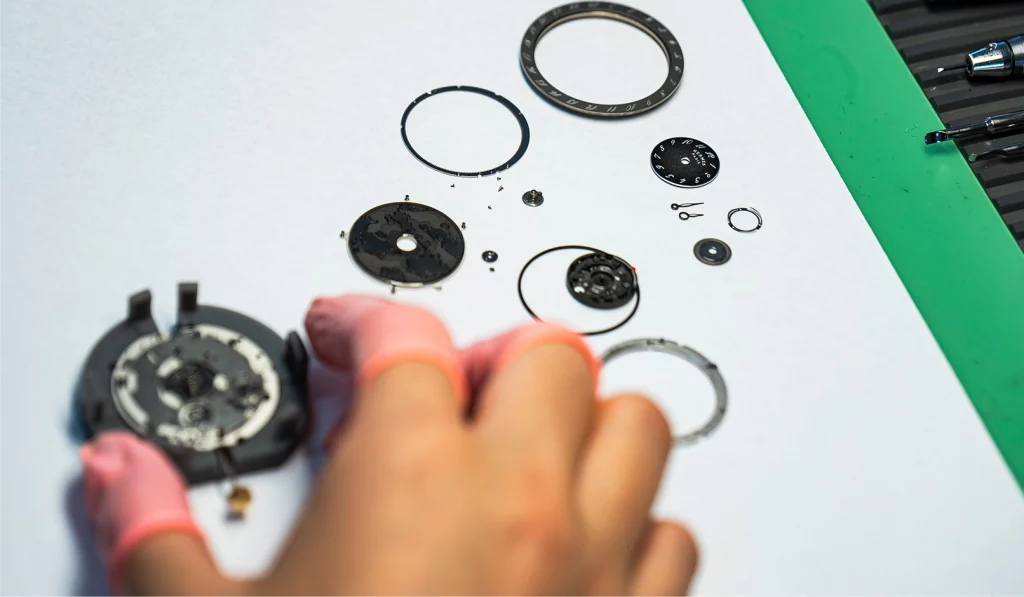
Final assembly is the ultimate stage in the development of a watch movement. After the design, prototyping, and validation phases, the caliber finally takes its definitive form, ready to be tested, regulated, and validated. This is the moment of truth, where technical precision meets the requirement of reliability.
Components checked before assembly
Before assembly, each component has already undergone a rigorous process: production, decoration, cleaning, and inspection. Parts intended for watch movement assembly must meet micrometer tolerances. The slightest variation can compromise the movement’s accuracy.
The watchmaker then assembles the components in a specific order, ensuring alignment, smooth power transmission, and mechanical stability. Every action counts: the pressure applied to a pivot, the engagement of a wheel, the installation of a spring. This sequence of operations transforms hundreds of independent parts into a coherent and dynamic mechanism.
Assembly is not merely a technical act; it is a craft. It demands patience, attention to detail, and a comprehensive understanding of the mechanism’s operation. At this stage, the watchmaker becomes the link between theoretical design and mechanical reality.
Mechanical adjustments and tension management
During assembly, internal stresses are monitored with extreme care. Springs, axles, functional clearances, friction points: every interaction influences the movement’s performance. Adjustments may be necessary to achieve perfect balance.
A slightly recalibrated spring, an adjusted height, a differently polished contact point: these precise corrections ensure the movement’s smooth operation. The goal is to obtain a stable, harmonious caliber ready to withstand the demands of real-time operation.
Mechanical adjustment is an invisible phase for the end user, but essential to a watch’s reliability. It is here that performance is refined, precision takes shape, and excellence is confirmed.
Watchmaking quality control: the decisive tests
Once the movement is assembled, the testing phase begins. Each caliber undergoes a series of rigorous evaluations as part of watchmaking quality control:
- Overall operation : all functions must engage and disengage without resistance.
- Power reserve : checking autonomy and energy management.
- Amplitude and precision : measurements of the pendulum’s behavior in different positions.
- Specific tests : shock resistance, thermal variations, behavior under stress.
These tests replicate real-world operating conditions. They validate the movement’s conformity to established design standards. No compromises are tolerated: only consistency guarantees reliability.
A process controlled from start to finish
The assembly of watch movements is based on three fundamental requirements: expertise, reproducibility, and traceability. The ultimate goal is clear: to deliver a precise, robust, and perfectly functional caliber, ready to be cased.
Every step is documented, every measurement recorded. This traceability ensures absolute consistency between prototypes and final production runs. It is this rigor that distinguishes fine watchmaking from industrial production.
The assembly of watch movements at Chronode
At ChronodeThe watch movement assembly is carried out entirely in-house by highly skilled watchmakers. Their experience with complex calibers allows them to achieve an exceptional level of expertise. Each movement is assembled, adjusted, and tested with unwavering precision.
Thanks to this integrated approach, Chronode guarantees the performance, precision, and reliability of every caliber delivered. Assembly becomes the ultimate expression of Swiss watchmaking expertise: a precise gesture, a shared commitment, a constant pursuit of excellence.
Assembling a watch movement : the moment when the mechanics come to life, when the idea becomes movement, and when perfection is tested in the detail.